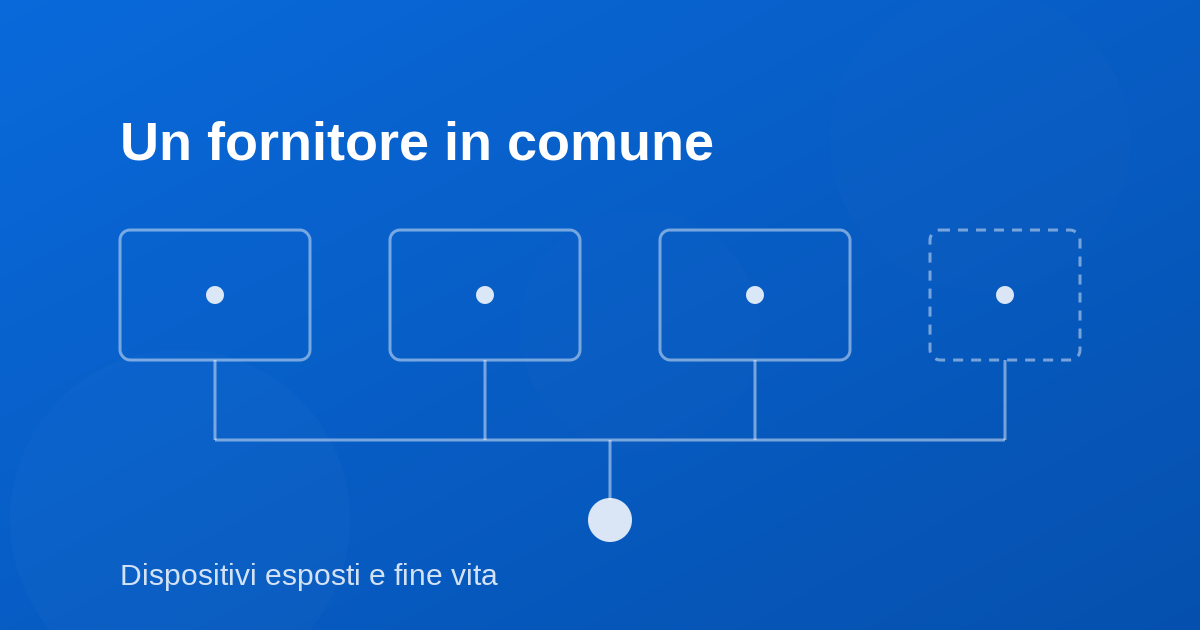
Different Companies, Same Incident: the Risk Is the Supplier
When several companies with nothing in common go down on the same day, the correct first hypothesis
is not a coordinated attack against a sector: it is one identical object installed in all of
them. The cleanest proof of that rule is the way national authorities described the cold
chain incidents of autumn 2026. France's CERT-FR, in alert CERTFR-2026-ALE-012, does
not publish a list of victims: it publishes a list of four product families. Italy's
National Cybersecurity Agency, in bulletin BL01/261013/CSIRT-ITA, names no vendor and no
store: it describes three technical conditions and states that the attack, by
exploiting them, allowed "the remote activation of defrost cycles and the modification of plant
operating parameters".
The practical consequence for anyone accountable for a company is that the perimeter you must defend does not match the IT org chart. It includes every device bought together with a service, installed by a third party, reachable from the Internet because somebody has to service it remotely, and in some cases out of support for years. In this article I reconstruct that mechanism using primary records only: two bulletins from a national agency, a state CERT alert, the manufacturer's own product bulletin and the three relevant CVE records. At the end you get a two-column table to fill in for your own plants, and the list of things that about this affair nobody knows, because knowing that is part of the method.
Method and scope
- Sources verified on 13 November 2026. The affair is open: every statement must be re-read at the source before being reused.
- Source levels. L1 = act of an authority, manufacturer advisory, CVE record, statute. L2 = specialist outlet with author and date. L3 = aggregators and self-serving claims. In this article every fact is L1: where it is not, I say so.
- No names of affected companies. Not because they are secret, but because none of the records I read contains them: the press carries them, and a victim's name taken from an outlet is an attribution I cannot verify. The teaching value is in the mechanism.
- Defensive scope. Nothing here explains how to attack anything. The checks described are performed on your own plants, agreed with whoever is accountable for them.
The four items answer a single question: how far can you trust what you are about to read. The date says how fresh it is, the level says who states it, the absence of names says what the article gives up knowing, and the scope says that the only action on the table is defensive, on systems of your own and with the agreement of whoever runs them.
The fact: a list of products instead of a list of victims
What the CERT-FR alert says, word for word
The alert is referenced CERTFR-2026-ALE-012, first version 12 October 2026,
last version 16 October 2026, with a three-line changelog: initial version, "ajout
d'autres equipements cibles" on 13 October, "mise a jour des recommandations" on 16 October. The
Systemes affectes field lists four entries and no version numbers: Copeland xweb, Danfoss
AK-SC series, Danfoss AK-SM series, Dixell xweb. The summary says CERT-FR is aware of "nombreuses
compromissions" of the remote controllers of refrigeration installations of those series, and adds a
sentence that stands on its own: "De maniere generale l'exposition d'une interface de gestion sur
Internet est contraire aux bonnes pratiques".
The document can be downloaded and read with no special tooling. I include the commands because the point of this article is that primary sources get opened, not quoted second hand.
curl -sL -o certfr.html https://www.cert.ssi.gouv.fr/alerte/CERTFR-2026-ALE-012/
python3 -I -c "
import re, html
s = open('certfr.html', encoding='utf-8', errors='replace').read()
s = re.sub(r'(?is)<(script|style).*?</\1>', ' ', s)
t = html.unescape(re.sub(r'(?s)<[^>]+>', ' ', s))
print(re.sub(r'\s+', ' ', t))
"

# Output (run twice, identical): the text of the page on a single line, about 700 words.
# Excerpt: Référence CERTFR-2026-ALE-012 ... Date de la première version 12 octobre 2026
#          Date de la dernière version 16 octobre 2026 ... Systèmes affectés Copeland xweb
#          Danfoss série AK-SC Danfoss série AK-SM Dixell xweb
The block solves a small, frequent problem: reading an official document without going through whoever
summarises it. curl -sL follows redirects and saves the page; the Python script removes the
script and style sections and then the tags, decodes the entities and collapses
the whitespace, so the text becomes searchable with grep. Do not use it on a page that builds
its content in JavaScript, where it would return an empty shell, nor to download a whole site: here it is
a single public page of an agency, opened read-only.
The four things the alert does not contain
An alert is also read by subtraction. I searched that text for four things and found none of them: no CVE identifier, no ransom demand, no attribution to a group or a state, no count of affected stores. The Risque field reads "Non specifie par l'editeur". The same absences hold for the two Italian bulletins: neither names a CVE and neither names a manufacturer.
# on the extracted text of the alert and of the bulletins
grep -ioE "CVE-[0-9]{4}-[0-9]+" text.txt | sort -u          # expected: no result
grep -icE "rancon|ransom"            text.txt               # expected: 0
grep -icE "danfoss|dixell|copeland"  bulletin.txt           # expected: 0 on the ACN bulletins

# Output (run twice, identical, with text.txt = CERT-FR alert + BL01 + BL02
# and bulletin.txt = BL01 + BL02, extracted as in the previous block):
# (the first command prints nothing)
# 0
# 0
The block checks three absences instead of taking them for granted. In the first command -o
prints only the part that matches and sort -u removes duplicates, so a CVE identifier would
appear once; in the other two -c counts the matching lines, and the extracted text sits on a
single line, so the result can only be 0 or 1: read it as "present or not present", not as a count of
occurrences. The check holds only for the texts you extracted yourself and for their version of that day.
This is the easiest thing to get wrong when writing about security. The word "ransomware" has a minimum standard of proof, and that standard is a documented ransom demand. Where there is none, the word is not used: that is not editorial caution, it is accuracy.
Italy: two bulletins, and one bulletin re-promoted twice
Bulletin BL01/261013/CSIRT-ITA is titled "Misure urgenti di verifica e mitigazione per
operatori della distribuzione alimentare e della filiera del freddo" (urgent verification and
mitigation measures for food distribution and cold chain operators). It was published on
13/10/2026 at 12:44 with criticality Alto (89.97), and its changelog
has three rows: version 1.0 on 13 October, 1.1 on 3 November and 1.2 on 4 November, the last two with
the note "re-promoted to the front page following recent events detected on national territory". An
agency that puts its own bulletin back on the front page twice in two days is saying, in the language
of official records, that the phenomenon reached Italy.
On 4 November at 18:38 came BL02/261104/CSIRT-ITA, criticality Critico
(91.97), which extends the call "to all entities employing cold chain maintenance
technologies, regardless of their sector, and more generally to all entities using industrial remote
control tools". If you sell ice cream, store reagents or cool a server room, that sentence is about you.
The manufacturer says it itself: end of life, not "vendor breached"
The fourth record is the most underrated, and it is linked from the French alert itself: a Copeland Controls product bulletin dated 14 October 2026 on XWEB supervisors. The manufacturer writes: "Nous reconnaissons l'existence de la vulnerabilite identifiee sur une generation de controleurs XWEB EVO dont la commercialisation est arretee et qui est parvenue en fin de vie". And a little further down, in the list of steps: "Le XWEB EVO a atteint sa fin de service (End of Service) et ne recoit plus de correctifs de securite; le XWEB PRO est la plateforme prise en charge".
That changes the correct sentence to write. Not "that manufacturer was breached", which is an accusation against a real company that no record supports, but a product generation reached end of support and somebody left it on the Internet. The first statement looks for someone to blame; the second describes a condition you can check on your own plants tonight. In the same document the manufacturer also warns that both ranges ship with an identical factory account and explains how to replace it: I do not reproduce the credential here, because printing it helps no defender and the manufacturer's document is public and linked below.
The mechanism: the perimeter you purchased
The definition you need
I call purchased perimeter the set of devices that are in the company because they were bought together with a plant or a service, not because someone chose them for IT reasons. They share four recurring properties: a third party installed them; they serve a physical process, so switching them off has an immediate cost; they have remote access because the maintenance contractor must be able to work without driving to the site; and their life cycle is the plant's, measured in decades, not the software's, measured in years.
Everything else follows from those four properties, including the fact that the IT lead often does not know those devices exist: they never went through the IT procurement process.
The three conditions, in the words of those who wrote them
The summary of BL01 is the densest sentence in the whole affair, and I quote it in full because summarising it weakens it: "By exploiting obsolete installations, administration interfaces directly exposed on the Internet and deficiencies in authentication mechanisms, the attack allowed the remote activation of defrost cycles and the modification of plant operating parameters, causing the interruption of the cold chain and substantial economic damage."
Three conditions, not four, and lined up as an exploitation path, not as a list of good practices. Note the third one: the agency writes "deficiencies in authentication mechanisms", which is broader than "factory passwords were not changed". Default credentials appear elsewhere in the bulletin, in a sentence about possibilities ("vulnerabilities, insecure configurations and default or compromised credentials can allow the use of functions intended exclusively for operators and maintainers"), not in the account of what happened. The difference between "this is how it went" and "this is how it can go" is the difference between a report and a forecast.
The amplifier: one console governing a hundred sites
The fourth condition circulating in press accounts is not an entry point, it is a multiplier. BL01 puts it precisely: "The compromise of a centralised platform can therefore produce effects on multiple devices or sites". BL02 repeats it for entities in every sector. It is why a single access produces national news instead of a local breakdown: the very efficiency that lets two technicians manage two hundred stores lets one access reach them.
The mitigation the agency lists among its hardening measures is consistent and uncomfortable: "limit the privileges with which operators and platforms can act on multiple sites; verify that the compromise of a single store or account does not allow indiscriminate access to the other plants". It costs operational convenience. That is the price.
Why "apply the patch" does not cover the alert
This calls for arithmetic, not opinion. Three relevant CVE records exist, and they can be verified with one call to the CVE program API. I re-read them on 13 November 2026.
for id in 41450 41451 41452; do
  curl -s "https://cveawg.mitre.org/api/cve/CVE-2025-$id" \
  | jq -r '[.cveMetadata.datePublished[0:10],
            (.containers.cna.metrics[0] | to_entries[0] | "\(.key)=\(.value.baseScore)"),
            (.containers.cna.affected[0] | "\(.product) < \(.versions[0].lessThan)")] | @tsv'
done

# Output (run on 2026-11-13, identical twice; columns separated by tabs):
# 2025-05-08  cvssV3_1=8.2  AK-SM 8xxA Series < 4.2
# 2025-08-22  cvssV4_0=8.7  AK-SM8xxA Series < 4.3.1
# 2025-08-22  cvssV4_0=6.8  AK-SM8xxA Series < 4.3.1
The loop asks the CVE program API for one record at a time and jq extracts three fields:
the publication date (the first ten characters), the first metric with its score, and the product with
the lessThan version limit. If the record does not exist or the API changes shape,
jq prints null or an error: do not trust an empty field. The row of the table
below adds the weakness (CWE), which the command does not print and which comes from the same record.
| Record | Published | Metric and score | Weakness | Affected product |
|---|---|---|---|---|
| CVE-2025-41450 | 2025-05-08 | CVSS v3.1 = 8.2 | CWE-305 | AK-SM 8xxA, versions < 4.2 |
| CVE-2025-41451 | 2025-08-22 | CVSS v4.0 = 8.7 | CWE-77 | AK-SM 8xxA, versions < 4.3.1 |
| CVE-2025-41452 | 2025-08-22 | CVSS v4.0 = 6.8 | CWE-15 | AK-SM 8xxA, versions < 4.3.1 |
The arithmetic does not add up, and that is the lesson: the three records concern a single
product series, while the French alert lists four families. Whoever closes the three CVEs has
secured a quarter of the perimeter the authority described, and for the other three families there is
no patch to cite. One detail you only see by opening the record: CISA's SSVC block reports
Exploitation: poc and Automatable: no. That means public proof-of-concept
code exists and that exploitation is not mass-automatable. It does not mean those
CVEs were used in these incidents: no source I read states that, and neither do I.
The trade-offs, quoted where the people who wrote them wrote them
Disconnecting is not fixing
CERT-FR devotes an all-caps note to this, and it is the most important passage in the alert: "Maintenir une exposition Internet a un equipement sans correctif de securite (End of Life - EOL) est l'exposer a une tres forte probabilite de compromission. N'effectuer qu'un Reset Factory est dans ce cas insuffisant, les persistances d'une instance compromise seront supprimees mais l'equipement restera vulnerable et sera certainement de nouveau compromis".
Translated into a decision: on an end-of-life device a factory reset evicts the guest but leaves the door. The only measure that changes the outcome is removing Internet reachability, and then scheduling replacement. The Italian agency reaches the same conclusion from another direction: "isolation is a temporary measure and does not restore manufacturer support nor eliminate the vulnerabilities present".
IP address filtering: useful today, not a solution
Both authorities concede the shortcut and put an expiry date on it. CERT-FR: "Dans l'urgence, un simple filtrage des IP sources des prestataires frigoristes sur un pare-feu est possible, mais cette solution ne doit pas etre consideree comme perenne". The Italian agency: "Where removing the exposure is not immediately feasible, temporarily restrict access to trusted IP addresses, strengthen monitoring and define timescales and responsibilities for securing it". The element that turns the shortcut into risk management is that last clause: a date and a name. Without them, the temporary becomes the architecture.
The constraint that comes before the screwdriver: the contract
The French recommendations contain one line that looks like no other line in a technical document, and it appears before the technical steps: "Verifier les conditions contractuelles d'assurance avant de couper la remontee des donnees Internet vers le prestataire frigoriste". Check the insurance contract terms before cutting the data feed to the refrigeration contractor.
The reason is that the feed often is the policy: continuous telemetry is the evidence that goods were kept at the right temperature. Cutting it at night, alone, to close an exposure, may solve a security problem and open a liability one over the goods. It is why the Italian agency insists that interventions be "coordinated among information security managers, plant managers and maintainers, avoiding uncontrolled interruptions of refrigeration".
Why there is no scanning command here
The temptation, at this point in an article, is to hand over an nmap one-liner against your
own public addresses. I will not, and the reason is in the bulletin: "Give priority to examining
configurations, inventories and already available traffic. Any active scans on OT devices must
be assessed and agreed in advance with the plant managers".
This is not bureaucracy. A refrigeration controller is a computer with real-time constraints and a network stack as old as the plant: a scan that is a non-event on a web server can be the event on that device. The correct sequence is therefore documentary first and active second, with the person accountable for the plant in the room. The order matters more than the tool.
Your turn
The two columns your inventory probably lacks
Point 1 of the Italian agency's immediate actions is a list of fields, and it reads like a specification: inventory "controllers, SCADA systems, HMIs, OT/IoT gateways, monitoring platforms and remote assistance services, indicating location, owner, manufacturer, model, version and support status". The corporate inventories I usually see have a name, an IP address and a criticality decided by eye. They lack the two columns that decide everything in this affair: who supplied it and how long it is supported.
You need them because they answer the two right questions. The first groups the risk: if one device from a supplier has a problem, every device from that supplier must be looked at the same day. The second tells you whether the "updated" column means anything: on an out-of-support device there is no future update, so the decision is not "when do I patch it" but "when do I replace it".
A concrete example: the file below has three rows and two suppliers, invented and declared as such (ACME Cold and Beta Plants do not exist, the models and names are placeholders). It is a layout to adapt, not a program: you do not run it, you fill it in. It shows what a useful inventory must be able to say when someone asks "how many devices depend on the same supplier?".
site;device;supplier;model;version;end_of_support;internet_reachable;owner
ce-01;refrigeration controller aisle 1;ACME Cold;XX-100;3.4;2024-12-31;yes;M. Rossi
ce-01;plant supervisor;ACME Cold;SUP-2;4.3.1;2029-06-30;no (VPN only);M. Rossi
mg-02;remote assistance gateway;Beta Plants;GW-5;1.9;unknown;yes;Beta contract

# the three questions this file must answer within a minute:
#  1. how many rows have internet_reachable = yes ?
#  2. how many have end_of_support in the past, or unknown ?
#  3. how many rows share the same supplier ?
The three questions, computed
Once the file exists, the answers are three lines of shell. The value is not in the elegance of the command: it is that the number becomes a sentence you can say to whoever decides the budget.
EXPOSED=$(awk -F';' 'NR>1 && $7 ~ /^yes/' inventory.csv | wc -l)
OUT_OF_SUPPORT=$(awk -F';' -v today="$(date +%F)" \
  'NR>1 && ($6=="unknown" || $6 < today)' inventory.csv | wc -l)
echo "exposed: $EXPOSED | out of support or unknown: $OUT_OF_SUPPORT"

# the risk group: devices per supplier, most widespread first
awk -F';' 'NR>1 {print $3}' inventory.csv | sort | uniq -c | sort -rn

# Output on the invented file above (without the comment lines), run on 2026-11-13,
# identical twice, confirmed by a second count in Python. The second number depends on the
# date you run it, because it compares end_of_support with today:
# exposed: 2 | out of support or unknown: 2
#       2 ACME Cold
#       1 Beta Plants
In the first command awk -F';' splits each row on the semicolon; NR>1 skips
the header, and column 7 must start with "yes", so "no (VPN only)" does not count. In the second,
column 6 is "unknown" or a date earlier than today: comparing dates in YYYY-MM-DD format
works as a string comparison, but stops working if you write dates in another format. Do not use it on a
file whose fields contain the semicolon.
The intersection that counts is between the first and the second: the rows that are both exposed and out of support are the ones CERT-FR's all-caps note is about. They have no patch, and they have a door. Those are not scheduled for next quarter.
The tool, and what it is missing
This site has an asset inventory mapper that does the central part of the work: it catalogues devices with iot and scada types, assigns an exposure level, computes a score and exports to CSV and Markdown, keeping the data in the browser. As I write, it does not have the two fields the Italian agency asks for in point 1, supplier and support status, and its score does not weigh them. I say so because I would rather send you to a tool while stating what it does not do: use it for cataloguing and add the two columns yourself in the export, until they are built in.
If instead the question in your head is "does this make me a regulated entity?", that is a different question with a different page: we handle it starting from the text of the annex of the transposing decree, not from an impression.
What is not known, and why it is written here
As of this article's verification date the following remain unknown: who carried out the attacks and whether the waves are the same hand; what the precise initial vector was, beyond the three conditions the Italian agency indicates; how many stores were affected, because none of the three records I read publishes a number; which devices were installed in the Italian cases; and why those interfaces were on the Internet, which is the most interesting organisational question and the one for which I have not a single source.
An article filling those five gaps with plausible reconstructions would read better and be worth less. The usable part of this affair sits entirely in the documents: four product families, three conditions, one generation at end of life and a contractual trade-off that precedes the technical one. The rest, when it becomes an official record, will be readable.
Tonight's step
- Open alert
CERTFR-2026-ALE-012and bulletinBL01/261013/CSIRT-ITA: they are short, and they are the source. - Ask whoever runs your technical plants one single question: which devices have access from outside, and who supplied them?
- Write the answers into a file with the two extra columns. Three rows are enough to start.
- For the rows that are exposed and out of support, set a date and a name. The rest is planning.
The order of the four steps is not interchangeable: reading the sources comes before the question because it tells you what to ask, the file comes before the deadline because without rows there is nothing to assign a date to, and the name of the person accountable is the only thing that turns a list of risks into a piece of work with an outcome. Being able to do this, with three rows and no scan at all, is already an inventory.
Frequently asked questions
Why does a list of products say more than a list of victims?
Because it identifies the shared factor. The affected companies share neither a parent company nor an IT department: they share a purchased device. The "affected systems" field of alert CERTFR-2026-ALE-012 lists four product families and no company name, and that is the information that lets a reader look for the same object in their own plants.
Do the three 2025 CVEs explain the 2026 incidents?
No primary source states that, and the arithmetic makes the explanation incomplete: the three records CVE-2025-41450, 41451 and 41452 concern a single product series, while the CERT-FR alert lists four families. Moreover neither of the two bulletins from Italy's National Cybersecurity Agency, nor the French alert, names a CVE. CISA's SSVC block in the records reports "Exploitation: poc", which means public proof-of-concept code, not confirmed exploitation in these incidents.
Does a factory reset secure a compromised device?
Not if the device is end of life and remains reachable from the Internet. CERT-FR says so explicitly: a Factory Reset alone removes the persistence mechanisms of a compromised instance, but the device "restera vulnerable et sera certainement de nouveau compromis". The measure that changes the outcome is removing the Internet exposure and planning replacement.
Which two fields are almost always missing from a device inventory?
Supplier and support status. Point 1 of the immediate actions in bulletin BL01/261013/CSIRT-ITA asks for devices to be inventoried indicating "location, owner, manufacturer, model, version and support status". The supplier lets you group risk when one manufacturer has a problem; the support status tells you whether the decision is to patch or to replace.
Can I scan my industrial controllers to find out whether they are exposed?
Not as a first step and not on your own. Italy's National Cybersecurity Agency recommends giving priority to examining "configurations, inventories and already available traffic" and specifies that any active scans on OT devices "must be assessed and agreed in advance with the plant managers". On devices with real-time constraints a scan can itself be the incident.
Why does this article not name the affected companies?
Because none of the primary records I read contains them: CERT-FR speaks of "numerous compromises", Italy's National Cybersecurity Agency of "numerous French supermarket chains", and none of the three documents publishes a store count. The names circulate in the press, which is a lead for finding the record, not the source of the fact. The mechanism can be taught without the names; a name attributed wrongly cannot be taken back.
Sources and further reading
All sources below are primary and were opened and read on 13 November 2026. Where a document is not reachable from a script, I flag it: it must be opened in a browser. The passages quoted from the Italian bulletins are my own English rendering of the original Italian; those from the French sources are left in French.
- CERT-FR (ANSSI), alert CERTFR-2026-ALE-012 - "Incident de securite ciblant les controleurs a distance des installations de refrigeration". First version 12 October 2026, last version 16 October 2026. Product list, recommendations, note on end-of-life devices.
- ACN / CSIRT Italia, bulletin BL01/261013/CSIRT-ITA - "Misure urgenti di verifica e mitigazione per operatori della distribuzione alimentare e della filiera del freddo" (urgent verification and mitigation measures for food distribution and cold chain operators). Published 13/10/2026 12:44, version 1.2 of 04/11/2026, criticality Alto (89.97).
- ACN / CSIRT Italia, bulletin BL02/261104/CSIRT-ITA - "Sicurezza dei sistemi a supporto della catena del freddo e interfacce di management di sistemi connessi" (security of cold chain support systems and management interfaces of connected systems). Published 04/11/2026 18:38, criticality Critico (91.97). Extends the call to every sector using industrial remote control.
- Copeland Controls / Dixell France, product bulletin of 14 October 2026 - "Avis de securite relatif aux systemes de supervision XWEB" (PDF) - the manufacturer acknowledges the vulnerability on an end-of-life generation and declares end of service. This is the document linked from the CERT-FR alert.
- CVE-2025-41450 record, CVE-2025-41451 and CVE-2025-41452 - CVE program API. The publication dates, CVSS metrics, weaknesses and version ranges quoted in the table come from here. To read them as a page: cve.org.
- Legislative Decree 138 of 4 September 2024, in Gazzetta Ufficiale Serie Generale no. 230 of 1 October 2024 (PDF) - the Italian transposition of Directive (EU) 2022/2555. Cited here only as a pointer: title, date and Gazzetta number confirmed on Normattiva on 13 November 2026; article 25 "Obblighi in materia di notifica di incidente" (incident notification obligations) read in the text published in the Gazzetta. Later amendments must be checked on the current text on Normattiva: the article does not examine them. This is not legal advice.
Commenti
Caricamento commenti...
Sign in to comment